|
Part One of the two part article on Azam
Khan
 Greatest
of them all? Greatest
of them all?
The least-acclaimed of all the great squash
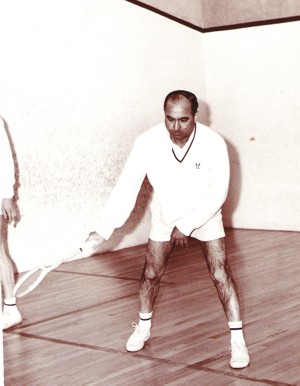
Khans, Azam migh have been the greatest of them all, claims Ijaz Chaudhry in
part one of a two-part article.
Winning the British Open four times in
succession is no mean feat, yet Azam Khan, who achieved just that between
1959 and 1962, has not been given due recognition by sports historians.
There is a reason for this. His victories came at a time when the British
Open was already Pakistan’s domain. His elder brother, Hashim Khan, had won
the title as many as seven times before him, so only those with comparable
achievements are mentioned in the same breath: Jahangir Khan, Jansher Khan,
Geoff Hunt and Jonah Barrington. Nevertheless, some people are of the view
that Azam Khan was the greatest of them all – and there are reasons for this
too.
Now 81 years of age and settled in England since 1956, Azam Khan owns and
runs the New Grampians Squash Club in London. Osteoarthritis in one knee
forced him to stop playing squash a few years ago but he still spends a
couple of hours every morning at his club doing exercises, including
cycling.
I asked him to tell me about his journey in squash from the beginning. How
was he lured into the game?
“I was a
tennis coach at the officers’ club of the Pakistan Air Force. My elder (and
only) brother, Hashim, who had won the last two British Opens, told me to
switch to squash. I was 26 at the time and had never played the game.”
Yet within
two years of Hashim’s bidding, Azam was ready to take on the best in the
world.
“The Air
Force raised the funds for a trip to Britain through exhibition matches in
various bases. My first competition there was the British Professional
Championship, where I defeated the British no.1 in the semis and lost to my
brother in the final. Despite this, the Squash Rackets Association [now
England Squash] was reluctant to allow me to enter the British Open of 1953.
“I was
pushed into a ‘trial’ match against the British no.1, which I won easily.
Even then I was not given a seeding and I had to face the no.2 seed in the
first match. I dispatched him in three straight games and progressed to the
semi-final, only to lose again to my elder brother.”
But Azam
Khan had arrived on the world squash scene, and the very next year he
reached the final of the British Open for the first time, losing to ... who
else but Hashim. And the 1955 final was a replica of the previous year’s.
“At this
point, British newspapers started running headlines such as ‘Family Affair’.
So in next two Opens we were kept in the same half of the draw and came face
to face in the semi-finals.”
According
to Azam, Nusrullah Khan, who was holding office at the SRA, played an
important part in this arrangement. “Thus Nusrullah helped his brother
Roshan to progress to the final of both the 1956 and the 1957 Opens, where
he faced Hashim. A ‘just draw’ was restored in 1958 and Hashim beat me again
in the final.”
But the
following year, the ‘crown prince’ took over. In 1959, Azam won the coveted
title for the first time, beating his nephew Mohibullah in the final in
straight games. He went on to win the title four times in succession.
“The most
memorable of those four triumphs was that of 1960. I trounced Roshan Khan [a
distant relative] 9-1, 9-0, 9-0 in the final. It’s still the shortest final
in the history of the tournament, lasting just 19 minutes.”
This had
other repercussions. The paying public felt short-changed, so the organisers
decided to introduce a play-off for third position for losing semi-finalists
before the final.
Azam was
at the peak of his powers when he last appeared on the professional circuit
in 1962. That year, he had won not only the British Open and British
Professional titles but also the most important hardball tournament, the US
Open, for the first time. Azam then had to retire from competitive squash
due to an Achilles tendon injury. The injury healed in 18 months but he
never returned to the circuit.
“Yes, the
Achilles healed but another wound never healed. I completely lost interest
when my 14-year-old son died in 1962. Thereafter my squash activities were
confined to my club.”
There was
a brief interlude – and it was in the land of his birth. “I was on a private
visit to Pakistan in late 1963 when the Pakistan Squash Federation [PSF]
invited me to play in the National Championships. On their insistence, I
reluctantly agreed. I had remained crippled by the injury to my foot for
about a year and a half and not only was completely out of practice but also
found it painful to play. Moreover, I hadn’t played on cement courts for
several years. I still managed to win the final, overcoming Roshan Khan, who
was ranked in the world’s top three at the time. A few days later, I also
won the Pakistan Open, again defeating Roshan in the final.”
“I settled
in England in 1956. Since then, I’ve been to Pakistan off and on. My last
visit was in 2000, when I was invited to a function organised by the PSF to
honour Jahangir Khan.”
Why did he
leave Pakistan?
“Although
I was a coach in the Pakistan Air Force, I’d been employed as a porter, with
a monthly salary of 60 rupees (equivalent to five British pence at the
current exchange rate). In 1953, when I reached the semi-final of the
British Open on my maiden appearance, I was promoted to ‘electrician’ and my
salary rose to 100 rupees per month. But the following year, when I finished
runner-up, far from being promoted I was demoted back to the level of
porter. The reason given was that the post of electrician no longer existed.
“As I
said, the Air Force only provided us with a return ticket; during my stay
abroad, I had to take care of my own board and lodging. And unlike these
days, there were very few tournaments which offered prize money. Principal
among them were British Open, the British Professional, the Scottish Open
and a few hardball tournaments in the USA and Canada. So it was difficult to
survive.
“In 1956,
I played an exhibition match against Hashim Khan at the New Grampians Club
in Shepherds Bush. After the match, the owner of the club approached me and
offered me the job of coach. The offer included a salary as well as
accommodation. I had no option but to accept it.
“The owner
wasn’t in good health and in 1957 he asked me to take over the club. I
didn’t have the financial resources to buy the club, so he asked me to pay
in instalments over a period of five years. That’s how I became to own the
club.”
Hence
Azam’s association with the club is more than half a century old. And during
this period it has been associated with the emergence of several outstanding
players.
“The very
person who halted the Khan era in British Open history, in 1964, was a
product of this club. Mike Oddy of Scotland ousted the defending champion
Mohibullah Khan in the semi-final, thus achieving the distinction of being
the first Briton since 1953 to reach the final – which he lost to Abou Taleb.”
The club
is also linked with the development of arguably the greatest squash player
Britain has ever produced – a story that sheds light on what Azam might have
achieved had he continued with his squash career. Read it in Part 2 of this
article, coming soon.
King Khan
 Ijaz
Chaudhry continues the story of Azam
Khan, four-times winner of the British
Open. Ijaz
Chaudhry continues the story of Azam
Khan, four-times winner of the British
Open.
The Egyptian Abou Taleb had won the British Open three years running, from
1964 to 1966. He then threw down a challenge that if anyone beat him, he
would pay him £500 – at least £5,000 in today’s money.
“At the instigation of a couple of club members, I accepted the challenge,”
recalls Azam Khan, now 81 and proprietor of the New Grampians Squash Club in
London. “The challenge even appeared in the newspapers. But Taleb chickened
out, saying that he should be given £1,000 before the match because if he
lost he wouldn’t be able to face people in Egypt and would have to settle in
another country.
“The members of my club then said that they wanted to bring in some young
player and hand him over to me. Thus entered Jonah Barrington. At that time,
Barrington worked in a mill. He used to come early in the morning to have
squash training from me and then left for the mill. Despite this ‘hurried’
training, I made him ready to challenge for the very next British Open, in
1967.
“The day before it started, Barrington played a match against me and could
take only one point in three games. He was so depressed that he wanted to
withdraw from the tournament. But I knew the prevailing standard and
encouraged him to go ahead.”
The rest is history. Barrington not only won the 1967 Open but went on to
win the title five more times. But after winning his first title, he again
played against Azam – only to lose in the same manner as before.
“After 1963, the British Open title remained outside Pakistan for more than
a decade. But I played a part in the next Pakistani victory. Air Marshal Nur
Khan, who had become chairman of Pakistan International Airlines in 1973,
made earnest efforts to revive Pakistan’s squash fortunes. When he came to
England, he invited me to return to Pakistan to help. But I couldn’t leave
London as I had to look after my club as well as my family.
“Nur Khan persisted and suggested that some Pakistani players be sent to
England to be trained by me. I agreed and put forward the names of Qamar
Zaman and Mohibullah Khan Jr. For six weeks, they prepared for 1975 British
Open under my supervision. And Qamar Zaman ended the long drought by
bringing back the title to Pakistan. The following year, Qamar Zaman was
again asked by Nur Khan to avail of my coaching. But Qamar refused and, as
you know, Pakistan had to wait for the emergence of Jahangir Khan in the
early 80s to regain the coveted crown.”
Like the sons of the great Khans of his era, Hashim and Roshan, Azam’s son
Wasil excelled in the sport that had brought fame to his father. Once hailed
as one of the hottest young properties in English squash, Wasil won his
county title at the tender age of 15 and later a British Junior Open title.
He could not fulfil his early promise, but his daughter, Carla, has been
active on the professional circuit since 1999. Interestingly, a few years
ago, she changed her allegiance from her country of birth, England, to the
country of her grandfather’s, Pakistan. Carla reached her highest world
ranking of 21 in 2004, a year in which she defeated Nicol David, now world
no.1.
When it comes to describing his style of play or the strong points of his
game, Azam is evasive. “This is for others to do,” he says. Here is how
Jonah Barrington describes Azam in his book ‘Murder in the Squash Court’:
“If Hashim was the most devastating savage of the great Khans, and Roshan
the most beautiful stroke player, Azam would have been the little
accountant, methodically arranging all the bits and pieces of the game,
having everything under close analysis, nothing out of place … he was
meticulous, organised, ruthlessly clinical and very deft … he was
unbelievably efficient … he constantly sucked you into situations from which
it was impossible to extricate yourself … he was totally silent on court,
like a little bird. There was none of this stamping and pounding that one
hears so frequently these days; he moved like a ghost, silently hither and
thither. Yet wherever you hit the ball, he was there.
So why has Azam remained in the shadow of the other great Khans? This
intriguing question alludes to the numerous rumours that the Khans had their
own rules of ascendancy: that the younger ones were allowed to rule the
roost not when they were better, but when the elders decided that their time
to step up had arrived. It is certainly ‘suspicious’ that in the three
British Open finals Azam lost, his opponent was his elder brother, Hashim.
Azam neither confirms nor denies the
rumours, but says simply: “Respect for an elder brother is very much
ingrained in our Pushtun culture. The words bhai sahib [respected
brother] meant everything to me. He was my coach and mentor.”
A member of the most successful family the game has ever seen, Azam Khan was
also directly involved in the grooming of world champions from his adopted
land as well as the country of his birth. He was a great champion in his own
right. But for two factors – first respect for his brother and later
mourning for his son – Azam Khan might have been the greatest squash player
of all time.
Perhaps he was. |