 VERSION
FRANÇAISE
VERSION
FRANÇAISEPreparation,
Preparation!
|
Former World Champion
|
| T minus 36 (Take-off minus 36 hours) |
How do you get yourself ready for a tournament? Let’s say you are a club
player, you play squash regularly, between 2 and 3 times a week. Ordinarily,
a Club player will have a tournament starting on the Friday evening, and
finishing on the Sunday afternoon, if he or she goes all the way.
So, we are
talking about one match on the Friday, two on the Saturday and one or two
matches on the Sunday. We are going to look at three different aspects of
the preparation before a match.
- Physical preparation
- Mental preparation
- Diet
| Let's start 36 hours before the match ... Thursday Morning |
Physical preparation:
If you have to take a day off in your physical
preparation, Thursday is NOT a good day. Choose an earlier day during the
week, like Monday or Tuesday, even Wednesday, but I would definitely have a
game on the Thursday. Once again, I’m talking about an averagely fit player,
not a pro, and not an unfit beginner. Try to keep the game on the easy side,
between 45min and an hour. It shouldn’t hurt too much, avoid a really hard
game.
That is quite a change if you compare it to the preparation that was
recommended about 20 years ago. At that time, you were advised to have hard
games on Monday, Tuesday and Wednesday, and to have a day off on the
Thursday, which would freshen you up and make you ready for Friday. For me,
taking Thursday off was not a good idea! The body has an unbelievable way of
developing a memory, both physically and mentally. If you have a day off on
the Thursday, you tend to tune out physically, so your body goes from your
last game on Wednesday afternoon or evening to nothing Thursday and most of
Friday and then be expected to blast off into a very hard game on the Friday
evening. Don’t forget that the hardest game of any tournament could be the
first round. That could be the match that may determine the whole
tournament.
So, do something on Thursday, it’s important. Neither too hard a game, nor
too easy!
Mental preparation:
You should be thinking about your game about 5 minutes
in the morning, and about 10 minutes in the afternoon. If you know who you
are going to play, think about the last time you played him (or her) or how
he or she plays. If you don’t know who you are going to play, going through
a bit of mental squash, using basic technique, and the way you normally
play.
Diet:
Try to avoid too much alcohol, too many beers. Try to cut down to one
glass of wine, or one beer. Too much alcohol will definitely affect your
performance and slow down your game. It could affect you for only 5 minutes
at the start of a match, but those 5 minutes could be crucial. In the same
token, try and avoid any big meal, including red meat or anything heavy that
is going to take a long time to fully digest. Choose instead carbohydrates
like pasta, and proteins like chicken, white fish or white meat, that will
digest much faster. Don’t forget that your body spends a tremendous amount
of energy digesting heavy food. That is why you feel so tired for so long
after eating a heavy meal!
|
We are now at Friday morning. |
|
Mental preparation:
You should start thinking about the match, not for too long, but just like a reminder: I have got a squash game tonight. That works for me, because I’m a fairly relaxed sort of person and I don’t get too nervous thinking about squash. If you are the sort of person who gets really nervous, then try not to think about it too much. |
|
Physical preparation: As a rule: do nothing strenuous! If you get the chance (most of the club players don’t, as they rush from work straight to the competition on the Friday evening), you could go and have a gentle hit on your own. It shouldn’t take up any physical energy at all and should not last more than 10 to 15 min. It’s nice to go through the routine again: getting changed, light stretch, light hit, having a shower, and going home. It’s like a rehearsal for that evening. It’s quite important for the development of that memory I was talking about earlier. If you can do this, it may just give you the edge. |
|
Diet:
Don’t eat a heavy meal at all, you’d be better off having a lot of light snacks, sandwiches are ok, but nothing like a cooked English breakfast for example. Go for the typical continental breakfast, full of carbohydrates. |
|
We are now at Friday afternoon. |
| Mental Preparation from T
minus 6 T minus 6, Friday afternoon The diet and physical preparation aspects will be the same for everyone but the mental preparation may vary according to each individual. We are all very different, and we all react differently to certain situations. So, for somebody like me, fairly relaxed mentally, I’m now thinking about the game and I’m going through a very light mental rehearsal: I’m on the court, I’m in a rally, nothing special, just driving up and down the wall. I do that for a couple of minutes every hour. If you find yourself getting in a bit of a state, it would pay to either think about something else, or do something else that occupies your mind, like listening to music. Music can relax you when you become too anxious. If you get anxious or hyperactive before a match, you’ll find that you’ll be using energy, all that adrenaline will be pumping around your body and not being used, and if it doesn’t get used, it makes you feel tired. Adrenaline is a fantastic substance if it comes through when you need it; if it comes when you don’t need it, it actually makes you feel tired. T minus 2 Start thinking about your match for about 5 minutes every hour. Now, imagine that you haven’t done any of the preparation we have been talking about, the most important time where you can make up a lot of ground is: T minus 1 This is definitely the most important time. Personally, I would go somewhere quiet and on your own. About half an hour to forty minutes before the beginning of your match, go to the changing room, get changed. While you are changing, keep away from people, have your own thoughts. As you are putting on your clothes, yours socks and shoes, as you are folding your clothes, putting them in your locker or in your bag, you are thinking about the game of squash. You are focused. Mental preparation is essential; it will give you positive energy. But be realistic. If you’ve played someone seven times, and you have lost seven times, and if you are absolutely sure and certain you are going to beat them, that’s being unrealistic. Go out there and think, I may not win, but I’ll be going out there to push as hard as I can and that in itself could produce a surprise result. In sports, if you become too unrealistic, you become disappointed. Now, if you have beaten him seven times out of seven, then you’ll be going on court, not to prove that you are a better player, but that you can do it again. But it may not happen, and you’ve got to keep that element of doubt in your mind because you can feed on that, and that alone can give you energy as well. Mental preparation is absolutely crucial, especially the mental rehearsal of the match. What I do, is that I imagine how I’m going to start up in the match, driving up and down the wall, getting some lengths, getting established before I start getting short, and before I start boasting, or going for volleys. I’m going to get established by driving up and down the wall, looking at lengths, lengths, lengths, boast, go up there, drop, then back to length, length, length. I’m just mentally doing that. Now, you are in the changing rooms. You can speak with people, but don’t get into any heavy conversations with anybody. Try not to get too anxious. You should get just get a few butterflies in your stomach. Try and remain as positive as you can. Without being sexist, women are sometimes more vulnerable to having negative thoughts. Men seem to react to a competitive situation a lot better than women, again, it’s a generality, but, I have observed that fact quite a few times. Once again, the advice I give here are one person’s point of view, and as we are all different, whatever works for you is fine. |
|
Physical Side from T minus 6 T minus 6 Do NOTHING up to half an hour before your match. T minus 30min Then you’ve got to do your warm up. Three main points: Warm the body up: you should feel warm, or just a light sweat, nothing heavy, and not more than 10 minutes. Stretching: Your normal routine Squash specific exercises for 2 or 3 minutes: very important, and people very often don’t do it. For example, you are on the T, you run up, and pretend that you playing the ball, and you come back to the T, and off you go again, about ten times. This should last 45 seconds. Again, not too hard. Why is it so important? If you stretch out, and get straight on the squash court, your legs feel shaky, you feel awful, because you have actually stretched your muscles and your ligaments beyond what they are normally used to. The squash specifics will bring them back down to your strongest point. |
|
Diet from T minus 6 Try and avoid any sugary drinks, even the ones with glucose which are supposed to be good for you. Also avoid coke, tea or coffee, as their diuretic effects are not that good before a match. Water, plain and simple water is what you need. Don’t over do it either, you could end up being thirsty all the time and feeling really uncomfortable. If you feel like having a cup of tea, go and have a glass of water. If you drink coke for example, it is full of caffeine and sugar, you’ll be up for a while, and then you’ll feel like you have no energy at all. Don’t forget, for every up, there is a down. And your energy level will be so up and down you won’t be able to rely on it. Try to eat a light lunch, like a sandwich and a salad, or light pasta, around 4, 4.5 hours before a match; that will leave a good 3.5 hours without eating anything. Of course, depending on your age, your metabolism changes. For me, I wouldn’t have anything to eat 4.5 hours before a match. Someone younger could bring that down to 3 hours.
|
During the game, drink plain water. Not ice cold water, just simple water. I personally don’t believe in energy drinks while playing. After the match, yes, you should drink energy drinks. I find the effects make me thirsty during a game. You can have those drinks after you finished the match.

|
First Round Pitfalls |
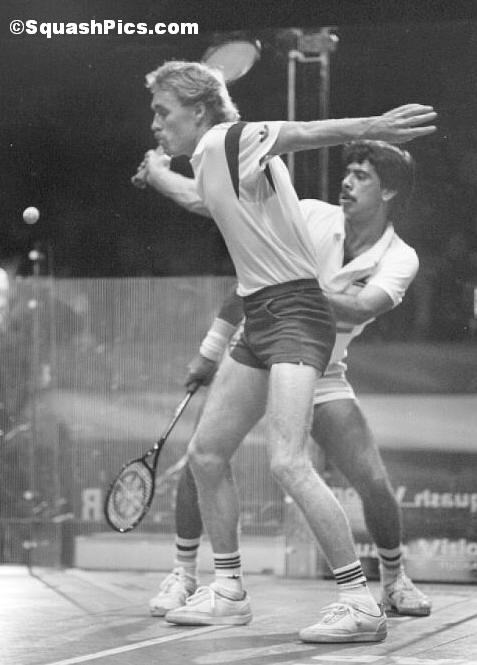

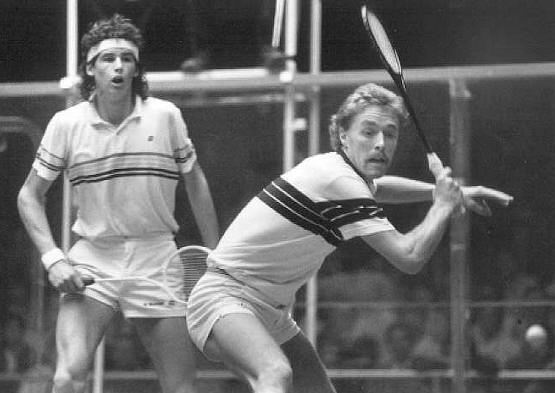
| Jahangir Just to give you an example, one day Jahangir was about to go on court, and the changing room was full of people. Everyone wanted to talk to him, so he got changed, and said, I’m just going to the toilet, and he stayed there for 20 minutes. He did nothing, just sat there mentally preparing himself for his match. |
| T DELAYED Now, what happens if your match is delayed for an hour by the previous match on court? Have a banana! It’s a fruit that will only remain in your system for 45 minutes. You could eat a banana, and then be on court 2 to 3 minutes later and not feel as if you’ve eaten anything. If you start to feel hungry, if your stomach starts to rumble, you need food. Don’t ignore the signs because if you do, your body will start closing down its energy levels. If you eat a piece of bread, or a chocolate bar, you will feel it in your stomach for an hour or so later. A banana should be fully digested in 45 minutes and you will have tricked your body by giving it something to eat and avoid the shutting down of energy levels. |
|
Have a great tournament ... Ross Norman |