 JOHN WHITE: JOHN WHITE:
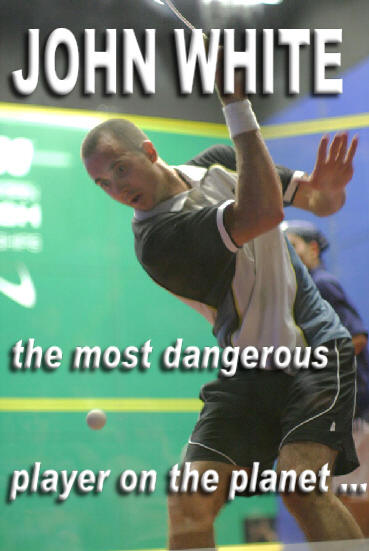
THE MOST
DANGEROUS
PLAYER ON THE PLANET |

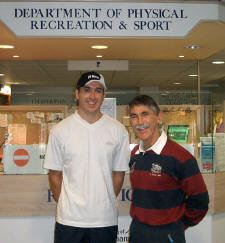
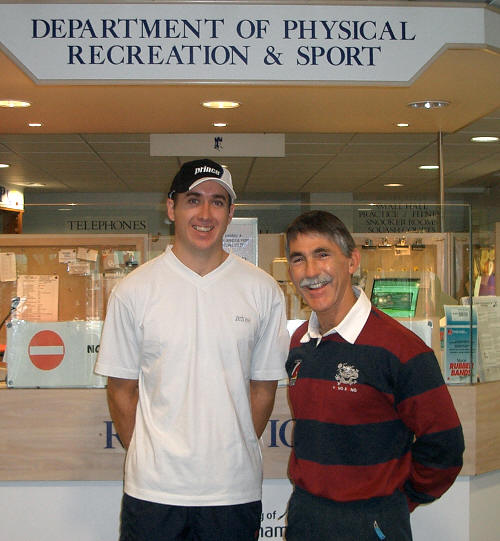
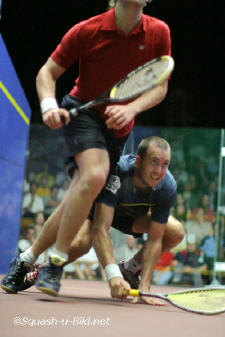
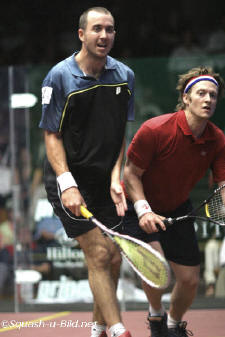
John with Vaughan Williams
JOHN WHITE
FACT FILE:
Born: June 15, 1973, Mount
Isa, Queensland, Australia.
Entry to squash: Parents owned a club.
Lives: Nottingham, England.
Family: Wife Susie, children Tyler and Kyra.
Represents: Scotland.
PSA: On Tour since 1993.
Current ranking: 3 (August 2003).
Honours: Seven PSA titles, including Flanders Open 2001, PSA Masters 2003, English Open 2003.
Close calls: Runner-up World Open 2002, runner-up British Open
2002, Runner-up Swedish Open 2003.
Major strength: Power. Simply awesome
power. And great touch. You never know what's coming next. Now he's
maturing, he's learning to be patient, and therefore even more dangerous.
When the UN weapons inspectors searched Iraq for those weapons of mass
destruction, they should have headed for Nottingham, and watched John
White unleash one of those cannonball backhands.
SPONSORS
Rackets: Prince
Shoes: Prince
Clothing: Prince
Website:
www.jwsquash.com
|
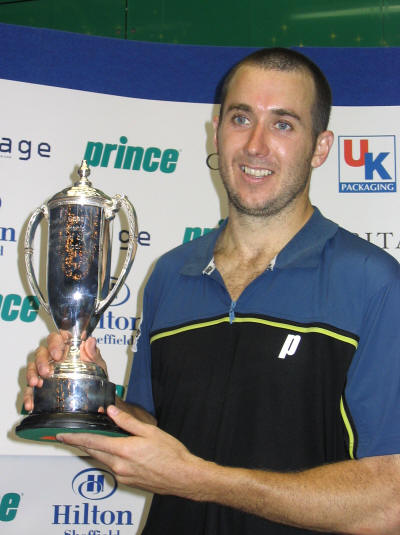
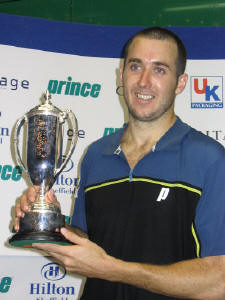
John White last week added
the English Open title to the PSA Masters trophy he won earlier in May.
John is now looking fitter and playing a brand of squash capable of
destroying all of his rivals at the top of the world rankings.
Much of the credit for his improved conditioning is down the volume of
work he has put in over the past two years with Vaughan Williams, the
Director of the University of Nottingham Sports, Leisure and Athletics
departments.
We asked John to talk us through the various training programmes he is
currently undergoing and how they evolved.
Q1: John, how did you first make contact with Vaughan Williams?
I was talking to Gawain Briars (the PSA Chief Executive who is chairman of
the Nottingham club) about the move to Nottingham and finding a trainer in
the area. He told me about the work he used to do with Vaughan and so he
contacted Vaughan and arranged a meeting with him and then it all started.
Q2: How did you start developing a training programme?
Vaughan showed me the programme he had set out, which he has had for many
years, to show me what I would be doing for training. I went and did a
session to see if I liked the programme which I did and have been doing
for the last 2 years.
Q3: What was it that made you realise that a new training regime
would help your career?
I had not been working to a set routine for some time and knew it had to
change, as it was not getting me any results. I needed to get someone to
work with on a regular basis and to push me into the right direction.
Q4: How have you developed the workload over the past two years?
We keep a log of what we do each session and where we are improving and
where we can put more workload into the sessions. We do a maximum session
every so often just to see where my fitness and strength levels are, and
look at the difference from a normal session to a maximum session. We then
can see where the improvements are and where we have to put a little more
work in.
Q5: John, you now seem to have as much fitness and stamina as
any one on the circuit. Please tell us what routines you do on a regular
basis.
We do a set routine of plyometric and cone movements two to three times a
week which last around 1hour 30minutes. Depending on how I feel after the
session we will go outside and do short sprint work for about 15 minutes.
When I am not seeing Vaughan I go to the gym and run or ride for around
40-60 minutes, working with the heart rate monitor. I try to keep the
heart rate as high as it would be in a tough squash match situation. Over
the summer break we do a lot of strength work in the gym and longer
sessions of short and long sprints, 5-50metre sprints. As it gets closer
to a tournament I would get on court for routines or matches to get the
body and mind ready for the event
Q6: Was it easy to get your head round it to start with?
I think Vaughan and I hit it off from the start which made it all that
easier for the change of training. He tells you how it is and if I need to
pick the training up a little he does. I needed that push in the right
direction for training.
Q7: Is it all new stuff, or a variety of new routines and some
tried and trusted ones?
The plyometric work I had done before, back in Australia with Joe Shaw,
and liked doing them. If there is an exercise that I have pain from doing
we change it for another. It is all old fashioned training which I think
is the best.
Q8: You seem to have a good support team around you, with a
solid base at Nottingham Squash Club, a training programme devised by
Vaughan Williams, analytical and statistical help from Scottish Squash,
and frequent input from Joe Shaw back in Australia. Plus, of course, your
family. What roles does everyone take and how do you rotate your time
between each sector of the above?
The Park Squash Club is a fun club and a very laid back place, which I
like very much. They are all great people and always up for a good laugh.
The video analysis from Scottish Squash has helped greatly by showing and
proving to me where I need to improve on the court. They can break a match
down and show you straight away where you are improving and where you may
still be giving away too many cheap points.
As for Joe Shaw, what can I say about that crazy old man? He was my first
ever coach and the first to say that I could be one of the best, way back
12 years ago. I have gone back to do his routines on court which has
helped me get the rally count up and the error rate down and it has
worked. I would not listen to him back then but now I am doing the work on
court.
Family support is great. One of the biggest things that help me mentally
during a tournament is that I talk to my dad or get texts from him from
Australia. He just reminds me of getting good line and length and that he
and mum are with me all the way.
Knowing that the kids are home with Susie and that they have a good
routine while I am away is a great weight off the shoulders. I know when I
travel I don't need to worry about things at home. It makes it that more
enjoyable as well when they can come to events close to home. I love it
when my little man Tyler can come and watch me play.
Q9: With all this input, how would you
say you have you changed your game over the past couple of years?
I have become more patient and changed my attacking game to a more basic
game of squash. I am happy to rally and wait for the opening before trying
to put the ball away. Before I used to try to put the ball away too early
from the back but that definitely has changed. The old Johnny White still
comes out now and again but not for too long.
Q10: I imagine that goal setting is
part of your development. Have you achieved your goals for 2003?
I have definitely achieved the goals so far for 2003. They were to get
back to my highest of No.3 and to win a few tournaments to close the gap
from 2 and 1. My ultimate goal is to get the top spot of No.1 by the end
of the year.
Q11: And have you worked out your next
set of goals?
If I can get the top spot the first goal is to
hold onto it for as long as I can!! We are in the middle of setting more
goals for the rest of the 2003-04 season.
Q12: Losing the 2002 World Open final
to David Palmer after holding match ball must have been a devastating
blow. You seemed to be a bit flat for a while after that. Is that a
reasonable assessment?
I was sick to my stomach for some time after the Final of the worlds and I
could not really answer any questions properly about it either. To be so
close and not come away with the title was very disappointing indeed,
especially when I had my parents, wife and kids
there. The couple of months break was great after the TOC. I was able to
go away and completely relax and forget about the tour for a while. Did a
lot of thinking and made a lot of changes which now are starting to pay
of.
Q13: You lost to Thierry Lincou in New
York in February from two games up, but then beat him in straight games in
the PSA Masters final in Qatar. Was that a measure of how you got things
back on track this year?
The changes and the break after the TOC was the biggest help to get me
back on track. The lose to Thierry, not to take
anything away from him, was another blow from 2-0 up. Once I lost the
third I was thinking that "it's going to happen again" and once I had that
in my head I guess it was all over from there. Thierry got stronger and I
got more negative as the match went on. That was one of the major areas I
had to fix up and I did.
Q14: You have obviously travelled the
world many times. Is Nottingham now a permanent family base for you?
For now it is. We have got some great friends and set up the house the way
we like it to be. We will have to see what comes around when the career is
over
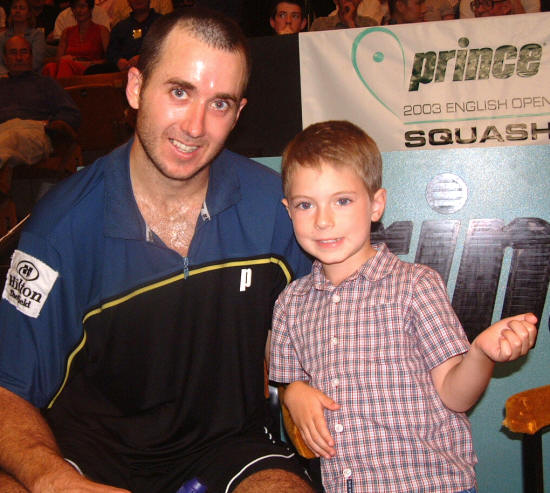
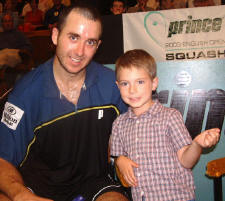
Q15: There were some delightful
pictures of your son perched on your lap after the final in Sheffield. Is
he set to follow in his father's footsteps on the squash court?
At the moment he is into all sports. I'm not going to force him into
anything. It would be great to see him follow in my footsteps but we will
have to wait and see.
Q16: When you get home after a
tournament, do you talk much about squash?
No, not at all, which is great. I analyse what happened during an event
and then leave it at that and go on with family life.
Q17: How do you switch off when you
take a break from the game?
I do as much as possible with the kids. I have taken Tyler to golf a
couple of times. Most of the time we spend at the park or with playmates.
Q18: You must be looking forward to
the British Open being staged in Nottingham.
It is great that it is only five miles from the house. I can bring the
family to see me play again. Hopefully the supporters from our Tuesday
night National League matches will come and support during the event,
which is also a great thing to have so close to home.
Q19: And, finally, how DO you hit that
backhand so hard?
That I am sorry I can NOT answer!!!
John, many thanks, and good luck in the Open.
Visit John's new website:
www.jwsquash.com
|