|
BRITISH OPEN 2000
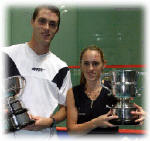
Men's Final:
David Evans (Wal) bt Paul Price (Aus)
Women's Final:
Leilani Joyce (Nzl) bt Sue Wright (Eng)
FINAL ANALYSIS AND MEMORIES
By ALAN THATCHER
THE Millennium Year British Open will go down in history as the tournament
that changed the face of professional squash.
The success of the live television broadcasts by Sky Sports has opened up a
whole new range of commercial opportunities for the game. If that quality of
TV coverage can be repeated on a regular basis then life will become
considerably rosier for event organisers, promoters and the game's governing
bodies.
Fact One: Nothing significant in sport happens without sponsorship. Fact Two:
Very little sponsorship is placed without the benefits of TV coverage to
satisfy the demands of the major companies now being approached to bankroll
the game's major events, plus a wave of new tournaments on the horizon.
The fact that TV rights companies such as Fablon and ProCam are committing
themselves to investing in long-term relationships with the the game is not
based on a benevolent desire to help the sport out, and rescue established
events that appear to have been struggling to find sponsorship.
No, those decisions are based on hard-headed commercial facts. Worldwide
television sales, plus sponsorship fees, ticket income, and the sale of
exhibition stands and corporate hospitality packages, equals profit.
If those profits can help the game's shop window to develop, and at the same
time attract new players to the sport, thereby increasing all manner of
racket, equipment and clothing sales - not to mention boosting club membership
figures - then EVERYBODY in the sport wins. Not just the deal-makers.
CONGRATULATIONS to David Evans and Leilani Joyce for lifting the two
British Open titles at the National Indoor Arena in Birmingham.
When the celebrations have died down, I am sure that Evans will learn from the
experience, just as Joyce did last year when she won the title for the first
time in Aberdeen.
That success was just Chapter One in the Leilani Joyce Story. To repeat it,
and challenge Cassie Campion for that coveted world number one slot, she knew
she had to work on several aspects her game. This year she returned to Britain
looking fitter, faster, leaner and keener. She powered her way through the
event without dropping a game, and her court coverage is now
simply phenomenal.
She looks more patient, too. Last year, when on the verge of victory against
Cassie - in a match when nerves clearly got to both players - she snatched a
couple of shots in her desire to get the match over with. Now she appears to
have the confidence to place the ball more accurately, work her opponent
around the court, and wait to see what they can come up with,
knowing that it will take a very good shot indeed to cause her any problems.
That kind of containing strategy worked very successfully for David Evans
against a tiring Paul Price in the men's final. Price is a great shot-maker,
and at times could hit nicks at will from any area of the court, but as
fatigue took over his margin of error went off the Richter scale and he
started drilling the tin instead of firing winners.
Evans, on the other hand, hardly made a mistake in the first two games, using
his enormous reach to retrieve the ball safely and comfortably, and working
the ball to a length to keep Price behind him.
Evans was delighted with his winning run, and surely everyone was
alerted to his potential threat after that stunning performance against Ahmed
Barada in a second round full of surprises. Straight away after beating
Price, Evans admitted that there was still plenty of room for improvement in
his game.
He said: "Winning one title is a marvellous achievement, and especially
the British, but to do it on a regular basis I know I have to work on things
like speed, fitness and suppleness. Peter Nicol is probably the hardest worker
in the game and I know that's what I have got to do to put him under
pressure."
In a week of shock results, two matches stood out from the others for the
sheer consistent quality of both players throughout each contest Ð and both
matches featured Aussie Joseph Kneipp. He produced an astonishing recovery to
beat Martin Heath in the second round just when the Scottish world number five
appeared to have his game flowing perfectly in all directions. But somehow
Kneipp weathered the storm and in the fifth game he was on such a high that he
was able to counter all of Heath's attacking artillery with a dazzling array
of winners of his own, conjured up from all parts of the court.
His reward was an all-Australian quarter-final clash with Price, who bravely
clawed his way back from the brink of defeat to win 17-16 in the fifth.
Perhaps it was that marathon effort that left him looking so drained in the
final. But, considering Price had been out of action of for most of the year
with a back injury, he can be more than pleased with his performances in
Birmingham.
The players at the top of the men's rankings have been warned. The old order
is changing.
From an English perspective, Mark Chaloner is clearly approaching something
like his best form again, as his victories over Paul Johnson and Alex Gough
proved before he fell to Price in the semi-finals. But early exits for Simon
Parke and Peter Marshall (and Johnson) were clearly disappointing to the SRA
staff coaches.
Sue Wright, now working (almost)
full-time for Prince and playing (almost) for fun, surprised everybody by
reaching the women's final, leaving a trail of younger, fitter and ultimately
perplexed players in her wake. I don't think those opponents found it much
fun, finding themselves embroiled in a succession of lets, blocks and nudges,
but I hope they watched the final and learned from Leilani Joyce's
performance. Nobody is going to give you anything in this game, and, until
those players can adapt their tactics to a variety of situations, then they
will continue to come off second best.
Cassie's injury was another huge blow to English pride, and I would like
to know the full story of her spectacular loss to Tania Bailey in New York the
following week Ð without wishing to take anything away from one of the most
promising young players in the game.
Tania has shown she is capable of beating the world's best, and maybe next
year, when the event is moved to June, she will be up there challenging Joyce,
Campion, Carol Owens, Linda Charman and Sarah Fitz-Gerald for the most
prestigious prize in the game.
|